As Dr House is wont to say, "everybody lies".
But some do it with statistics.
It therefore behooves us to read the news (and any thing really) critically.
Or else we might just get swept along by some "influencer".
And it's not even necessarily some sweaty ranty conspiracy theorist. It might even be mainstream media.
Showing posts with label Behavioural Economics. Show all posts
Showing posts with label Behavioural Economics. Show all posts
Sunday, 24 February 2019

Monday, 20 August 2018
HIP 2 is not hip and not a real option.
First reaction to the NDR 2018.
Home Improvement Programme 2 is supposed to work hand in hand with VERS. At that time, owners of 70+ year old flats will be offered 3 options.
1) HIP 2. This will cost money. For a flat with "decaying" value. You will also suffer the inconvenience of improvement works.
2) Voluntary Early Redevelopment Scheme (VERS). This will give owners some benefits.
3) Do nothing, and run out the lease. No costs. No benefit.
Option 1 is to "motivate" owners to choose VERS (option 2).
So faced with the three options, what would you choose?
Option 1?
I don't think so.
Home Improvement Programme 2 is supposed to work hand in hand with VERS. At that time, owners of 70+ year old flats will be offered 3 options.
1) HIP 2. This will cost money. For a flat with "decaying" value. You will also suffer the inconvenience of improvement works.
2) Voluntary Early Redevelopment Scheme (VERS). This will give owners some benefits.
3) Do nothing, and run out the lease. No costs. No benefit.
Option 1 is to "motivate" owners to choose VERS (option 2).
So faced with the three options, what would you choose?
Option 1?
I don't think so.
Monday, 26 February 2018
Graveyard of Bikes Problem.
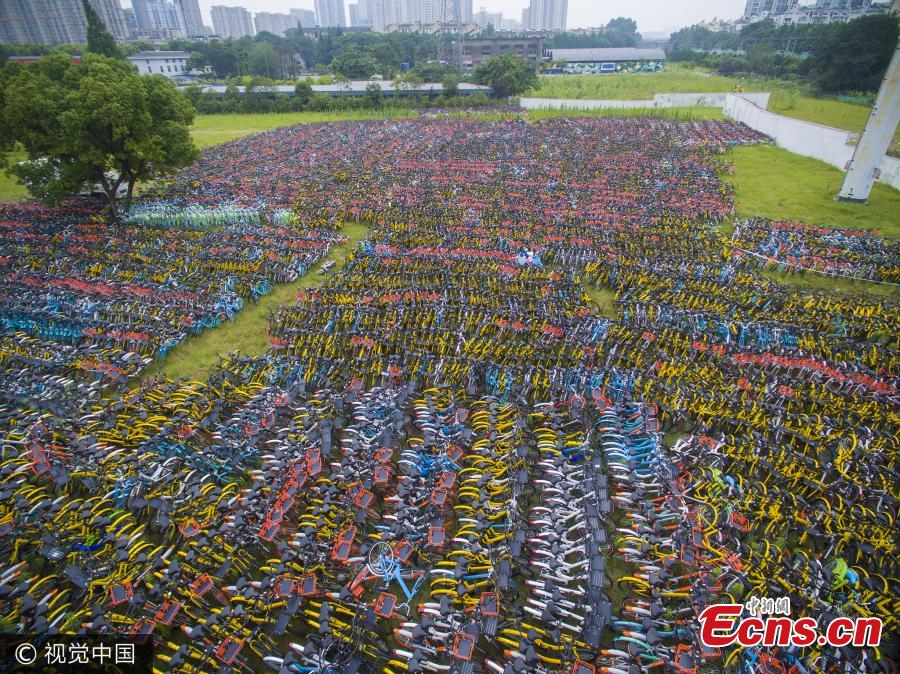 |
| Hangzhou's bike "graveyard". Tens of thousands of shared bikes parked on an empty field in Hangzhou City, capital of East China’s Zhejiang Province, June 26, 2017. Hangzhou authorities have temporarily suspended the use of more than 20,000 shared bikes found in violation of traffic rules, including improper parking. Companies that own the bikes have not been active in getting them back. (Photo/VCG) |
Firstly, what is the problem? Users are not parking the bikes properly? What is "properly" when there is no space? What is properly when all lots have been taken up or all the space in the yellow box is filled up? Want the Bike Sharing Companies to build docking stations? For how many bikes? Say they build 20 at a location, but 40 bikes come and need space to park. Or they build 10 docks and there are NO bikes there, but the docks continue to take up space even when empty. The problem is that there are TOO MANY so-called SHARED BIKES.
Why? Because the manufacturers of these bikes are making money making and selling bikes to Bike Sharing Co. Ironically, I saw this on one of the shared bikes: "Consume less. Share more."
Except "bike sharing" ISN'T sharing. It's renting.
Sunday, 28 January 2018
How to solve the bike sharing mess
One foreigner (Bulgarian) was civic minded enough to try to to solve the problem of the bike sharing mess.
Bulgarian living here rounds up Singapore’s damaged rental bikes
Bulgarian living here rounds up Singapore’s damaged rental bikes
... Mr Girginov’s Volunteer Bike Patrol initiative has taken off, collecting over 400 damaged bikes in about seven trips.But this inherently strikes us as unfair. Why is a profit-making business depending on civic-minded volunteers to clean up their mess?
The group gathers the broken bicycles in one neighbourhood, moving them to a central location. Mr Girginov then rents a lorry for S$200 a trip to pick up and carry the bikes back.
Mr Girginov has funded the effort until now, but expansion might prompt him to consider crowd-funding or seek sponsors, he said.
Friday, 29 April 2016
Unemployment Insurance or Retrenchment Benefits/Severance pay?
First Sylvia Lim proposed Redundancy Insurance for workers who are retrenched.
Then Chee jumped on the bandwagon because... political advantage?
Here is a summary of the proposals by the various parties, and their stance on the issue. Note, I make no warranty as to the accuracy of the summary. It's from the internet. As is this blog.
But the summary and the attributed statement seems credible.
And Lim Swee Say has rebutted Sylvia's proposal.
Briefly, the rebuttal is that Redundancy Insurance is not needed in Singapore because unemployment is low and Singapore employers provides Retrenchment Benefits (RB) and work with MOM to find re-employment for retrenched workers.
The retort was: "That's like saying you don't need fire insurance because fires rarely occur, and in any case we have a fire brigade (or SCDF)!"
Then Chee jumped on the bandwagon because... political advantage?
Here is a summary of the proposals by the various parties, and their stance on the issue. Note, I make no warranty as to the accuracy of the summary. It's from the internet. As is this blog.
But the summary and the attributed statement seems credible.
And Lim Swee Say has rebutted Sylvia's proposal.
Briefly, the rebuttal is that Redundancy Insurance is not needed in Singapore because unemployment is low and Singapore employers provides Retrenchment Benefits (RB) and work with MOM to find re-employment for retrenched workers.
The retort was: "That's like saying you don't need fire insurance because fires rarely occur, and in any case we have a fire brigade (or SCDF)!"
Wednesday, 30 March 2016
Conversation - How to be The Real Singapore
"These two buggers really know how to play the system, man!"
"Who?"
"The couple who ran that website, 'The Real Singapore'. Blardy clever! Can earn half a million dollars in less than 2 years. And now, still can play out the Singapore Government, man!"
"They can play, but they already caught and charge in court. The girl even plead guilty and sentenced to 10 months."
"And we goondu. That is EXACTLY what they want!"
"Who?"
"The couple who ran that website, 'The Real Singapore'. Blardy clever! Can earn half a million dollars in less than 2 years. And now, still can play out the Singapore Government, man!"
"They can play, but they already caught and charge in court. The girl even plead guilty and sentenced to 10 months."
"And we goondu. That is EXACTLY what they want!"
Wednesday, 1 July 2015
Weaning Singaporeans off their cars
There was this article on the Straits Times about how to wean Singaporeans off their cars.
It was not a very good article. It was basically suggesting that Singapore introduces Trams... because "Trams are the number one means of public transport in Leipzig."
Anytime you read something that is basically gushing over something that works very well in some setting and suggests it be adopted by SG without considering the factors why it works very well over there... you have a dumb article.
Extract from the online comment:
It was not a very good article. It was basically suggesting that Singapore introduces Trams... because "Trams are the number one means of public transport in Leipzig."
Anytime you read something that is basically gushing over something that works very well in some setting and suggests it be adopted by SG without considering the factors why it works very well over there... you have a dumb article.
Extract from the online comment:
Trams? Old tech. And like the MRT, if a tram breaks down, the next one cannot move because they are on the same track. I've seen this in Melbourne.Subsequently, in a flurry of for and against letters to the forum page, writer after writer wrote in defence and attack of the proposal to "wean" Singaporeans off cars.
Trams need either powerlines or tracks or both. It means fixed infrastructures and that means inflexible application. Trams are old tech. Quaint, but may not be relevant or appropriate to Singapore..
The "Trams" of the future will be driverless/ autonomous "trams" that do not need to run on tracks. This gives them greater flexibility in application and deployment.
Thursday, 18 June 2015
GUTS 1: Moving towards Singapore 2.0. Part 3: Enterprising Singaporeans
The Grand Unified Theory of Singapore (GUTS) today
and what We need to move to SG 2.0
Part 3: How to Get Singaporeans to take more Risk
Part 1 covered the problems of Singapore today - An Ageing population, rising costs of living, Inflation from an emerging, rising China, the problem of home ownership, falling birthrates, rising healthcare costs, and the Sandwiched Generation.
Part 2, considered what Singaporeans want. Or need rather. And why we are so kiasu. And why Meritocracy leads one to the Just World Belief, and why that leads to justifying inequality.
In Part 3, we ask, "How to get a Singaporean to take more risk?" You may also want to read "The Third Freedom". which ends with the same question.
My Dental Surgeon - A cautionary tale?
The only certainty in life is uncertainty. Disasters, natural or unnatural, domestic or global can strike at any time and affect everyone, good or bad, smart or not, deserving or undeserving. Perhaps there is a role for government to provide a social safety net not because people are lazy "takers", but simply because misfortune strikes us all.
My dentist (or dental surgeon), who's in his sixties, had heart surgery a few years ago, recovered, but found that he had to carry on with his practice in order to pay off his hospital bills. Yes, he did choose to go to a private hospital, but it struck me that this was a doctor of dentistry (or whatever is the official qualification of a dental surgeon is), running his own business, presumably making a lot of money (or not. His rates were rather reasonable. Low even), but who still have difficulties when a medical or health crisis struck.
Tuesday, 18 November 2014
Rant of a Young Singaporean (TV Character).
From a Facebook post (13 Nov 2014) by ChannelNewsAsia Singapore:
"Taken from Episode 15 of "118", Channel 8's 7.30pm drama.
A translation from one of our viewers Gavin Neo :
Do you think I'm the only one anxious to earn money?
Go ask around among the youngsters today, who isn't anxious?
After serving NS, graduating from university around 23-24 years old, we'll turn 30 at the blink of an eye.
During this short period of time, we have to get married, get a house, have baby(babies), can we do all of these without money?
The cost for a HDB is at least $300K-$400K now. Let's talk about the most basic need for spending, if we were to work in the city(town), a trip back and forth via MRT is $5-$6. Sometimes we take a taxi if we're rushing for time, ERP alone is $6-$7. Having lunch, we need at least $5-$6. Grabbing a cup of coffee from a cafe (I'm guessing he's talking about Starbucks and/or Coffee Bean etc) is $6-$7!
As if that's not enough, we have to follow what the government want us to do, to get married earlier, to have baby(babies) sooner. I have to get a girlfriend first. If I don't grab a meal, have a drink, watch a movie and go overseas occasionally with her, plus gifting a few branded goods to her, even if I have the face of a superstar, no girl will want to be with me.
Some of us still want to further our studies, what about loans and helping out with the family's finances? And when it's time to get married, it cost at least $1000 per table. A wedding photo shoot will cost at least $3000-$4000, and all of these requires money money money!
My generation of young adults don't demand a quality lifestyle. Is it even possible to not earn some money now, even if we were to live a life of the absolute basic? You don't want to have a son to have to ask you to pay for his wedding and his house, do you?
Yes, I admit that what I did to earn money is a little extreme (I don't know what he did). I've made mistakes and I'm at fault, but my fault is because of what this society has made it to be!"
Tuesday, 26 August 2014
CPF Realities and Alternative Policies (CRAP)
The CPF is being reviewed. Again.
Because people aren't happy with it currently.
What are they unhappy about? Many things. Everything.
Here's a no-brainer prediction: Whatever the review recommends and is implemented, not everyone will be happy.
And it's not just that SOME people might be unhappy. That SOME people might include YOU!
Because people aren't happy with it currently.
What are they unhappy about? Many things. Everything.
Here's a no-brainer prediction: Whatever the review recommends and is implemented, not everyone will be happy.
And it's not just that SOME people might be unhappy. That SOME people might include YOU!
Tuesday, 17 June 2014
The Psychology of Poverty - A recent example
Recently (June 8 2014), the news highlighted the circumstances of the widow of a Changi Airport cleaning supervisor who was has killed in an accident in 2012. She had received almost $1m in donations and insurance payouts for the tragic death of her husband. Donors had felt sympathy for her and wanted to help her and her four children. The money is now all gone. And she is looking for work again to support her family.
Comments on the web were on the whole, angry.
Angry that she had wasted the money. Angry that donations given in good faith was not used to benefit her children, was lost within 2 years.
Angry that their sacrifices/generosity/kindness (donations) were in vain.
Were those comments fair?
Comments on the web were on the whole, angry.
Angry that she had wasted the money. Angry that donations given in good faith was not used to benefit her children, was lost within 2 years.
Angry that their sacrifices/generosity/kindness (donations) were in vain.
Were those comments fair?
Monday, 23 December 2013
Friday, 22 March 2013
How to contain HDB flat prices.
Minister for National Development, Mr Khaw Boon Wan in his budget 2013 speech promised cheaper housing, housing for lower-income singles ($5000 and below). However he also wanted to review the basic premise of public housing.
He raised four key questions:
However the answer to the 3rd and 4th question is simple: restrict the use of CPF for the purchase of HDB flats.
The History of the CPF... and the official watery history on the CPF website (Update: links no longer working. Looking for alternative websites with similar info).
CPF was allowed to be used to buy HDB flats from 1968. This was a good idea then, but it evolved into a juggernaut. The problem is as the CPF contributions rose, and as income (and so CPF) rose, there was all these money in everybody's CPF accounts that they COULD NOT touch, except to buy HDB and property.
People liked to use their CPF because it was not "real" money to them. Money is money because $10 can be used to buy a meal, buy socks, buy a t-shirt, buy a movie ticket, or whatever you want. The value of money is that it is freely exchangeable (fungible?). The limitation of money is that spending it has opportunity costs.
CPF money is not freely exchangeable and there is almost NO opportunity costs - there is actually: retirement, but that is so far in the future, everyone discounts it. You can use it to buy HDB flats (and a few other things, but mainly HDB flats) and private property. The simple fact is that HDB prices are propelled by CPF savings. The problem is that when you can buy HDB flats with your CPF... No, the problem is that you can ONLY buy property with your CPF savings.
If you track the prices of private property, when you could not use CPF to buy private property, private property prices rose slowly. Previous to 1981, CPF could not be used to buy resale flats. When this was allowed, and there SEEM (to CPF members) to be NO opportunity costs for using CPF money to buy property (the opportunity costs - savings for retirement - is "future discounted"), private property prices booms, property agents income boom, everyone was happy, and the economy grew.
But it was "future" growth brought forward at best.
You want to stop HDB flat prices from rising? Stop allowing CPF to be used for resale HDB flats. OR allow CPF to be used for resale but only up to the costs of NEW flats from HDB.
Resale HDB prices will fall.
COV can still be boosted by irrational exuberance. Or just irrationality. But when no one or few people can meet those ridiculous COV demands, it will eventually fall as well.
But this is a dangerous option if implemented too quickly or too heavy-handedly.
I thought that the government understood this problem when they implemented a limit on the CPF withdrawal to pay for resale flats (AWDL?). The problem was the limit was pegged to the valuation of the resale flat, so as valuation went up, the limit also went up and there was no "brake".
If the allowable limit were set to the HDB BTO flats price, then CPF can only be used to pay up to the BTO price (i.e. HDB concessionary price) for resale flats. This will be an immediate "brake" on prices.
However, as mentioned earlier, this would be too painful for home owners. So the limit should be set at BTO prices + a premium that would be equal or preferably slightly below what is the current resale market.
[27 Mar 2013 edit: The other policy changes were in 2002 and 2005. In 2002, the deposit for private property was reduced from 20% to 10%. This was further reduced to 5% in 2005, allowing more people to get into the private property market. So if you had saved up $20,000 in 2001, you could have put a down-payment for a private property for $100,000. In other words, you won't have been able to afford it. However, by 2003, your $20,000 would have allowed you to buy a $200,000 private property. And in 2006, a $400,000 property.]
Rein in the resale prices, and BTO prices which are pegged to it will be reined in as well.
The whole problem with the HDB New and Resale market is that they are chasing each other's tail. (In MS Excel, there would be an error message pointing out that there is a circular reference.)
BTO prices are pegged to resale prices in the area. Then new resale transactions will take into account the nearby BTO prices with a premium. Then the next BTO takes reference from the more resent resale transaction. Circular reference.
All the other suggestions are eye-wash. Between freehold and 99 year lease, the difference (according to some reports) is about 20%. That is for an infinity of difference. You think a 60 year lease will be significantly cheaper than a 99 year lease? Take a 30 year old HDB flat. Is the price cheaper?
Basic and premium fittings? How much savings will there be?
The inflation of HDB prices is a "monetary" inflation - too much CPF money chasing after too few HDB resale flats.
Curb that and the problem should be solved.
Brief history of the CPF from this post. (Update: links no longer working. Looking for alternative websites with similar info)
Timeline
1 Jul 1955 : CPF implemented.
1 Jun 1957 : Members are required to nominate beneficiaries for their CPF savings.
1 Sep 1968 : Public Housing Scheme introduced.
1 Mar 1972 : Pensionable government officers join the CPF scheme.
1 Jul 1977 : Special Account created.
1 Jun 1981 : Residential Properties Scheme, which allows members to use their CPF savings to buy private homes, was introduced.
1 Jan 1982 : Home Protection Insurance Scheme (HPIS) introduced.
1 Apr 1984 : Medisave Scheme/Account introduced.
1 Jul 1984 : CPF contribution rate reached its peak at 50 percent (25 percent from employer and 25 percent from employee).
1 Mar 1986 : CPF began paying market-based interest rates.
1 May 1986 : Approved Investment Scheme (AIS) introduced. Members are allowed to use up to 40 percent of their CPF savings to buy gold, shares, unit trusts and stocks.
1 Jan 1987 : Minimum Sum scheme introduced at S$30,000.
14 May 1989 : Dependants’ Protection Insurance Scheme (DIPS), which is a term-life insurance covering members in the event of death or permanent disability, was introduced.
1 Jun 1989 : CPF Education Scheme introduced. Members are allowed to draw on their CPFsavings to finance tertiary education in Singapore for themselves or their children.
1 Jul 1990 : MediShield Scheme introduced.
1 Jul 1992 : Medisave Scheme extended to the self-employed.
1 Mar 1993 : The Share Ownership Top-Up Scheme (SOTUS) was set up to help CPF members buy shares in government-owned companies.
1 Oct 1993 : The Basic Investment Scheme (BIS) and the Enhanced Investment Scheme (EIS) were introduced to replace the Approved Investment Scheme. Members are allowed to set aside a higher portion of their CPF savings (80 percent) for approved investments.
1 Jan 1997 : The Basic Investment Scheme (BIS) and the Enhanced Investment Scheme (EIS) were merged to form the CPF Investment Scheme (CPFIS).
1 Jan 1999 : Members are allowed to use Special Account savings to help meet their housing instalment shortfalls.
1 Jan 2004 : CPF members who turn 55 and are able to meet the CPF Minimum Sum are required to set aside a Required Amount in their Medisave Account when they make a CPFwithdrawal.
1 Jul 2006 : Contributions to the Medisave Account which are in excess of the Medisave Contribution Ceiling are automatically transferred to members’ Ordinary Accounts.
1 Jan 2007 : The cap on the CPF withdrawal limit for the purchase of private residential properties and HDB flats financed with bank loans was reduced.
1 Jan 2008 : The CPF Board began paying an extra interest rate of 1 percent per annum on the first S$60,000 in the combined accounts of each CPF member.
1 Sep 2009 : CPF Life introduced.
1 Jul 2010 : First $40,000 of members’ Special Account balances are not allowed to be used for investments.
1 Jul 2011 : CPF minimum sum reaches S$131,000.
[Note: The Minimum Sum progression over there years can be found here (Up to 2007).
(Update: links no longer working. Looking for alternative websites with similar info)
He raised four key questions:
- Should Housing Board flats continue to be an appreciating asset or return to being treated simply as a social need?
- Should the HDB build to meet sophisticated tastes or go back to basics?
- How to keep flats affordable while continuing to encourage couples to be prudent?
- How should public housing respond to the needs of an ageing population?
However the answer to the 3rd and 4th question is simple: restrict the use of CPF for the purchase of HDB flats.
The History of the CPF... and the official watery history on the CPF website (Update: links no longer working. Looking for alternative websites with similar info).
CPF was allowed to be used to buy HDB flats from 1968. This was a good idea then, but it evolved into a juggernaut. The problem is as the CPF contributions rose, and as income (and so CPF) rose, there was all these money in everybody's CPF accounts that they COULD NOT touch, except to buy HDB and property.
People liked to use their CPF because it was not "real" money to them. Money is money because $10 can be used to buy a meal, buy socks, buy a t-shirt, buy a movie ticket, or whatever you want. The value of money is that it is freely exchangeable (fungible?). The limitation of money is that spending it has opportunity costs.
CPF money is not freely exchangeable and there is almost NO opportunity costs - there is actually: retirement, but that is so far in the future, everyone discounts it. You can use it to buy HDB flats (and a few other things, but mainly HDB flats) and private property. The simple fact is that HDB prices are propelled by CPF savings. The problem is that when you can buy HDB flats with your CPF... No, the problem is that you can ONLY buy property with your CPF savings.
If you track the prices of private property, when you could not use CPF to buy private property, private property prices rose slowly. Previous to 1981, CPF could not be used to buy resale flats. When this was allowed, and there SEEM (to CPF members) to be NO opportunity costs for using CPF money to buy property (the opportunity costs - savings for retirement - is "future discounted"), private property prices booms, property agents income boom, everyone was happy, and the economy grew.
But it was "future" growth brought forward at best.
You want to stop HDB flat prices from rising? Stop allowing CPF to be used for resale HDB flats. OR allow CPF to be used for resale but only up to the costs of NEW flats from HDB.
Resale HDB prices will fall.
COV can still be boosted by irrational exuberance. Or just irrationality. But when no one or few people can meet those ridiculous COV demands, it will eventually fall as well.
But this is a dangerous option if implemented too quickly or too heavy-handedly.
I thought that the government understood this problem when they implemented a limit on the CPF withdrawal to pay for resale flats (AWDL?). The problem was the limit was pegged to the valuation of the resale flat, so as valuation went up, the limit also went up and there was no "brake".
If the allowable limit were set to the HDB BTO flats price, then CPF can only be used to pay up to the BTO price (i.e. HDB concessionary price) for resale flats. This will be an immediate "brake" on prices.
However, as mentioned earlier, this would be too painful for home owners. So the limit should be set at BTO prices + a premium that would be equal or preferably slightly below what is the current resale market.
[27 Mar 2013 edit: The other policy changes were in 2002 and 2005. In 2002, the deposit for private property was reduced from 20% to 10%. This was further reduced to 5% in 2005, allowing more people to get into the private property market. So if you had saved up $20,000 in 2001, you could have put a down-payment for a private property for $100,000. In other words, you won't have been able to afford it. However, by 2003, your $20,000 would have allowed you to buy a $200,000 private property. And in 2006, a $400,000 property.]
Rein in the resale prices, and BTO prices which are pegged to it will be reined in as well.
The whole problem with the HDB New and Resale market is that they are chasing each other's tail. (In MS Excel, there would be an error message pointing out that there is a circular reference.)
BTO prices are pegged to resale prices in the area. Then new resale transactions will take into account the nearby BTO prices with a premium. Then the next BTO takes reference from the more resent resale transaction. Circular reference.
All the other suggestions are eye-wash. Between freehold and 99 year lease, the difference (according to some reports) is about 20%. That is for an infinity of difference. You think a 60 year lease will be significantly cheaper than a 99 year lease? Take a 30 year old HDB flat. Is the price cheaper?
Basic and premium fittings? How much savings will there be?
The inflation of HDB prices is a "monetary" inflation - too much CPF money chasing after too few HDB resale flats.
Curb that and the problem should be solved.
Brief history of the CPF from this post. (Update: links no longer working. Looking for alternative websites with similar info)
Timeline
1 Jul 1955 : CPF implemented.
1 Jun 1957 : Members are required to nominate beneficiaries for their CPF savings.
1 Sep 1968 : Public Housing Scheme introduced.
1 Mar 1972 : Pensionable government officers join the CPF scheme.
1 Jul 1977 : Special Account created.
1 Jun 1981 : Residential Properties Scheme, which allows members to use their CPF savings to buy private homes, was introduced.
1 Jan 1982 : Home Protection Insurance Scheme (HPIS) introduced.
1 Apr 1984 : Medisave Scheme/Account introduced.
1 Jul 1984 : CPF contribution rate reached its peak at 50 percent (25 percent from employer and 25 percent from employee).
1 Mar 1986 : CPF began paying market-based interest rates.
1 May 1986 : Approved Investment Scheme (AIS) introduced. Members are allowed to use up to 40 percent of their CPF savings to buy gold, shares, unit trusts and stocks.
1 Jan 1987 : Minimum Sum scheme introduced at S$30,000.
14 May 1989 : Dependants’ Protection Insurance Scheme (DIPS), which is a term-life insurance covering members in the event of death or permanent disability, was introduced.
1 Jun 1989 : CPF Education Scheme introduced. Members are allowed to draw on their CPFsavings to finance tertiary education in Singapore for themselves or their children.
1 Jul 1990 : MediShield Scheme introduced.
1 Jul 1992 : Medisave Scheme extended to the self-employed.
1 Mar 1993 : The Share Ownership Top-Up Scheme (SOTUS) was set up to help CPF members buy shares in government-owned companies.
1 Oct 1993 : The Basic Investment Scheme (BIS) and the Enhanced Investment Scheme (EIS) were introduced to replace the Approved Investment Scheme. Members are allowed to set aside a higher portion of their CPF savings (80 percent) for approved investments.
1 Jan 1997 : The Basic Investment Scheme (BIS) and the Enhanced Investment Scheme (EIS) were merged to form the CPF Investment Scheme (CPFIS).
1 Jan 1999 : Members are allowed to use Special Account savings to help meet their housing instalment shortfalls.
1 Jan 2004 : CPF members who turn 55 and are able to meet the CPF Minimum Sum are required to set aside a Required Amount in their Medisave Account when they make a CPFwithdrawal.
1 Jul 2006 : Contributions to the Medisave Account which are in excess of the Medisave Contribution Ceiling are automatically transferred to members’ Ordinary Accounts.
1 Jan 2007 : The cap on the CPF withdrawal limit for the purchase of private residential properties and HDB flats financed with bank loans was reduced.
1 Jan 2008 : The CPF Board began paying an extra interest rate of 1 percent per annum on the first S$60,000 in the combined accounts of each CPF member.
1 Sep 2009 : CPF Life introduced.
1 Jul 2010 : First $40,000 of members’ Special Account balances are not allowed to be used for investments.
1 Jul 2011 : CPF minimum sum reaches S$131,000.
[Note: The Minimum Sum progression over there years can be found here (Up to 2007).
(Update: links no longer working. Looking for alternative websites with similar info)
Wednesday, 13 March 2013
Tweaking the COE scheme.
13 Mar 2013
Most people agree that there is something wrong with the COE scheme. If you ask them for specifics and dig deep, they are universally agreed on the problem of the COE scheme: they can't get one cheap.
Asked for a solution, and you will be amazed by their creative suggestions as to how the COE scheme should be tweaked in order to give them the best chance (or a sure chance) of getting a COE, and if they are particularly inventive, cheaply too.
Most people agree that there is something wrong with the COE scheme. If you ask them for specifics and dig deep, they are universally agreed on the problem of the COE scheme: they can't get one cheap.
Asked for a solution, and you will be amazed by their creative suggestions as to how the COE scheme should be tweaked in order to give them the best chance (or a sure chance) of getting a COE, and if they are particularly inventive, cheaply too.
Friday, 8 March 2013
COE, ERP and the Sunk Cost effect
Tweaking the COE scheme to take into account what we know about behavioural economics.
Quote from this article:
Quote from this article:
As one driver told me, the high cost of his car makes him feel that he should use it every chance he gets, so he drives to the office every day rather than taking the bus that stops almost at his doorstep.One unintended and unexpected effect from the COE scheme which was intended to reduce car ownership costs, and shift policy towards controlling car usage, was the "sunk cost" effect (or fallacy). The sunk cost effect is reflected in the quote above.
Subscribe to:
Posts (Atom)