Showing posts with label Population. Show all posts

Wednesday, 4 March 2026

Population, Foreigners, and the TFR

[Drafted Feb 2018)

In Oct 2014, at NUS Society, PM Lee gave a speech on Singapore at this inflexion point. And he made some comments about Singapore's population policy.

First, let's do some math.

[Warning: Heavy computation ahead.]


Friday, 10 June 2022

A half-baked CPF top-up scheme.

[First Drafted in Jan 2021]

So the govt has a matching top-up scheme (Jan 2021) to help Singaporeans aged 55 to 70 who do not even meet the Basic Retirement Sum in their CPF.

It's capped at $600 a year.

Up to 5 years, so technically, it's capped at $3000.

For reference the Basic Retirement Sum (BRS) is currently $96,000. (those turning 55 in 2022)

Tuesday, 10 May 2022

Do we need to say this again?

Every few years, some bright (and not so bright) mind will have an epiphany (or what he, or she thinks is an epiphany) and suggests the revolutionary idea of NS for Women. Like it is an incredible and groundbreaking  idea. Defence Minister Ng Eng Hen has put paid to the idea. 

"The minister pointed to how some had suggested, during the debate on the White Paper on Singapore Women’s Development, that women be enlisted for reasons of gender equality, in potential roles like nurses or teachers.
“Having reached this position of strength, should we for the sake of gender equality, now introduce NS for women?” he asked, highlighting how the Singapore Armed Forces (SAF), despite reduced manpower, has remained operationally ready by using technology and optimising resources.
“I think there are distinct pitfalls if conscription is implemented for any other reason than the critical need of military defence, whether it is for men or women.”
The “primary reason” for enlistment must remain to train a soldier who is able to defend Singapore, and to repel if not defeat an enemy who wants to invade the country, Dr Ng said... 
“These are inadequate justifications or reasons to mandate that someone must suspend individual liberties as a civilian, give up two years of his or her life, and if they do not, they go to jail, as our courts have sentenced NS defaulters.”
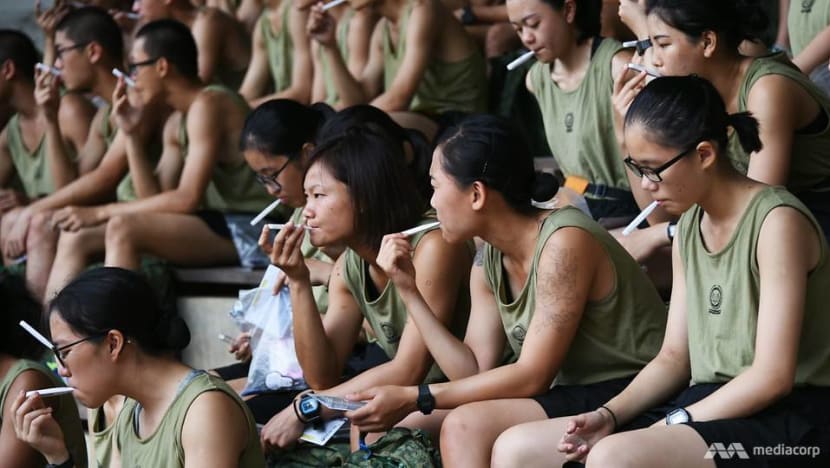
Should women do National Service now? Societal cost will 'far outweigh' benefits, says Ng Eng Hen
Female recruits who will go on to become regulars at the Basic Military Training Centre on Pulau Tekong
on Feb 11, 2020. (Photo: CNA/Try Sutrisno Foo)

He goes on to state that there is no need to conscript women now. Yes, in times of emergencies, women, younger men (teenagers) and older men would be conscripted as was done in Ukraine. But we are not in that position today, and hope never to be.

Saturday, 26 June 2021

Will China Grow Rich before it Grows Old?

 Short answer: China is growing old. This is inevitable. In 1980, there were 3 times more people in their twenties than there were people in their sixties. 

Now, the number of people in their sixties is almost as many as the number of people in their twenties. And there are fewer younger people (below 20) and more people in their fifties that will soon be in their sixties.

This is inevitable.

But, China could get rich, right?

Monday, 23 September 2019

"I believe the Children are our Future"

That is of course, a truism.

And it is cute to see children stand up for their future.

And drive the "Youth Revolution" that includes saving the Earth from Climate Change.

Ever heard of the Children's Crusade?

And then there are the survivors of the Marjory Stoneman Douglas High School shooting who became activists and lobbied for changes to gun control laws in the US.

Not to belittle their efforts - they made progress which had been impossible with the NRA and fanatical gun right lobbyists resisting change.

But... there are still mass shootings. Even as recent as August 2019.

Sunday, 10 February 2019

Singapore and Switzerland - a comparison

[This post was first drafted in 2015. So the figures are a little outdated, but updating them may simply be redundant for the argument. At least I assume so. Feel free to prove me wrong.]

You may recall at one point our former PM Goh Chok Tong promised/claimed that Singapore will reach Swiss Standard of Living. I checked. He made the "prediction" in 1984 that we would reach Swiss 1984 Standard of living by 1999. We made in in 2000. Just off by a year.

But there are still... sceptics.

Who are able to provide anecdotal or cherry-picked data to make their point.

This is not a rebuttal of their point, or points. This is a presentation of... the wider picture.

Friday, 9 November 2018

Being Right and Being Effective

Recently, the Intergovernmental Panel on Climate Change (IPCC) released a report that said the world needs to take drastic and unprecedented steps to hold global warming to a moderate but still devastating level. Every country will need to increase their commitment to reduce carbon emissions under the 2015 Paris Accord.

Also recently, Oxfam release their Commitment to Reducing Inequality Index that ranked Singapore very low (in the bottom 10) of countries making efforts to reduce inequality. Note that it does not assess that Singapore has inequality that ranks it at the bottom 10 countries. With a Gini index of 45.9, SG is 35th. US is 39th with a Gini index of 45. Philippines is 44th with 44.4. South Korea is 93rd with 35.7. (The lower the Gini Index, the less inequality.)

The point is not that SG’s inequality score Gini index is anything to crow about. But neither are we the worst. There are 34 countries with more inequality. But yes, we could do better in that. The issue is that the report simply castigates Singapore for not doing enough. And “enough” is defined solely, simply and only by Oxfam. Which to Oxfam means taxing the wealthiest, and giving money to the poor. You know, so that there would be less inequality.

And SPENDING a lot of money on Education. Regardless of whether that spending is having an impact. More on this later.

Saturday, 22 September 2018

"If you cut us, do we not bleed? If you praise us, do we not go crazy?"

From TODAY:

Is this for real? Readers get ‘political’ over Nas Daily’s videos on Singapore

21 September, 2018


National pride. Anti-government sentiments. A population who loves to complain and is ungrateful and negative. Credibility of online content. Freedom of speech. No, it is not Our Singapore Conversation in session, though it might as well be with the range of topics that surfaced after travel vlogger Nuseir Yassin, founder of Nas Daily, hit back sharply at those who questioned why he was "so effusive in his praise" of Singapore in various videos, challenging him to take up citizenship to see what it is like to live here. Mr Yassin labelled his critics "crybabies", sparking a social media storm.

Saturday, 31 March 2018

Wednesday, 7 February 2018

Patriots Act

You may have heard that Singaporeans rated Singapore the 31st most exciting city out of 32 cities.

But there's another survey by YouGov on 19 countries and the views of people in the countries in Oct 2016.

One of the question was how patriotic the respondents felt. Or rather they were asked if they thought that their country was the best in the world.

The country with the most people answering patriotically is... (drumroll)...

USA!

41% of the over 1000 respondents said that "My country is the Best Country in the World".

Another 32% responded that "My country is better than most other".

Tuesday, 29 March 2016

Fallback old age plan

In the news today (Mar 29 2016) was the story that more Japanese Retirees are committing crimes in order to be jailed so that they can get free accommodation, food, and medical care.

In other words, elderly criminals are turning Japanese Prisons into Old Folks Homes.

Or put another way, if the govt won't provide welfare one way, they'll end up providing welfare another way, anyway.

And it is not like Japan has a poor welfare system. It is in many areas better than SG's.

So would this happen in Singapore?

How to get state care in Singapore if you have not planned or provided for your old age. 
(Note: Some of these steps are illegal. But hey, if you go prison... free food and lodging!)

Tuesday, 14 July 2015

Hot, Flat & Crowded - highlights

From a review and summary of the book by Thomas Friedman, taken (with permission) from a note on Facebook.
Hot, Flat & Crowded is a book by Thomas Friedman who, as a book reviewer notes, "is a journalist, and journalists needs editors, and this book needs serious editing. It's 400 pages of small type. There's a 220 page book in here somewhere, struggling to get out."
This is not that 220-page book, but the highlights of the book.

First some explanations of the title.

Monday, 6 October 2014

Revisiting the White Paper

The Population White Paper was debated over a year ago, and it invoked a lot of responses.

Here's a ST forum letter that was savaged in a blog post.

And an excerpt of that forum letter:
The real issue is how we can control the cost of living - and, by implication, the labour component for businesses - and the rise of commercial rents, as well as ways to improve productivity.

I used to be amazed that a plate of fried rice in the United States could cost US$15 (S$19), and worry that this could happen in Singapore if inflation is not controlled.

Monday, 25 February 2013

Political Blues

WP has released their "Blue Paper" as a counter to the Government's White paper.

Devadas does a critical review of their Blue paper here.

I shall not rehash his critique.

But I thought the line: "Kitsch slogans hung on a line of wishful thinking" was an apt description.

As well as the observation that:
the WP population paper... is actually a cupboard empty of original ideas. All its policy recommendations are borrowed ideas from existing or proposed policies of the PAP. Boosting the Total Fertility Rate (TFR), raising the Labour Force Participation Rate (LFPR) of women and keeping the elderly employed and active are policies that have been in place for several years.
In other words,  it is exactly the same as the PAP's proposal... but DIFFERENT!

Monday, 18 February 2013

The WP are pulling figures out of their ARSE.


Why I say the WP are pulling figures out of their ARSE.

Almost as a reflex (almost, because I suspect they checked what the people's reaction were first before) they said a populist-advised "NO!" to 6.9m, and then they went on to counter propose a 5.9m projection. Based on what?

Based on giving Singaporeans what they want!

And what do Singaporeans want?

NO MORE FOREIGN LABOUR!

And the WP said, "No Problem! No further increase in Foreign Labour. We don't need them. If we FREEZE foreign workers, we can use local labour to make up the difference. We just need to INCREASE the labour force participation rate!

"The Labour Force Survey 2012 found that there are 418,000 economically inactive residents of working age, of which 90,000 are willing to work. This is a valuable pool of labour that can be tapped." 
(From WP website).

Really? Just like that and they can keep the population down to 5.9m?

Wednesday, 6 February 2013

Extract from Gerald Giam's parliament speech - WP alternative population projection

[Taken from WP website.]

6 Feb 2013
"We will target to increase our local labour force growth by up to 1% per year from now until 2030. We should strive to keep our foreign labour force constant between now and 2020, depending on our success in growing the local labour force. It does not mean that we shut the doors to foreign workers. Instead, new work passes will be issued only to replace expiring work passes or to supplement shortfalls in the local labour force. Companies will have to find ways to hire more Singaporeans.

["Companies will have to find ways to hire more Singaporeans." Wow. Good thing WP tell those companies to hire more Singaporeans. The PAP tell them, they won't listen one!]

Sunday, 28 October 2012

Revolt of the single taxpayer

Oct 28, 2012

Even as my tax dollars help support today's poor, I'm not assured of help when I'm old

By Chua Mui Hoong Opinion Editor


Like others seized by the ongoing conversation on Singapore's future, I've been ruminating on the kind of society I want to live in.

But rather than think of ideals and values, an exercise I consider unproductive (would anyone not want a kinder, gentler, happier, more gracious, more equal Singapore?), I prefer to contemplate the kind of political system I want, and the tax and benefits system I desire. I'll leave politics for a later date and focus on taxes today.

Many of us project our wants and desires of today into the future. We forget one thing: In 2032, we will be 20 years older. And as we age, our needs and desires change.

At 44, I favour a society with sufficient buzz with pockets of serenity. I want the economy to go for growth now while we can. I like Singapore's pro-business, open, competitive stance, because these translate into a good job with good pay, and a relatively low tax regime.

If you ask me today, whether I would support higher income tax rates, I would say "no", because I am a taxpayer and because the country's fiscal position remains strong.

In 2032, when I'm 64, I would want a quieter city, of slower growth, with low cost of living. I would likely support higher taxes, because I won't be paying taxes, but want high taxes to fund benefits I can draw from.

The distinction between what you want today and what you want in 20 years' time is too often overlooked in the national conversation.

And yet it can make all the difference in policy.

If you asked me: "Are you in favour of paying higher taxes?" I would say "no".

If you reframed the question: "It is Singapore in 2032. Are you in favour of paying high taxes?" I would say "yes", in secret hopes that I would be retired by then.

Also overlooked is the potential rift between the generations.

Those born in the 1980s are growing up in an era of very low personal income tax rates, and rising social benefits like Workfare and housing grants. Corporate tax is now 17 per cent; and the top personal income tax rate is 20 per cent. They used to be around 40 per cent in the 1980s.

If we mend the social safety net well, they are likely to retire in 2040 with better pension and health-care benefits than today's old.

Saturday, 14 July 2012

What to expect when you wait to have kids

Jul 14, 2012

They will have old parents whom they'll be taking care of earlier

By Nona Willis Aronowitz

WHEN my 79-year-old father had two back surgical operations a couple of years ago, I saw him in a hospital gown for the first time. As his closest family member - my mother died of cancer in 2006 - I gave my dad rides to the doctor and the grocery store. I helped him clean out his house and move into a smaller, stairless apartment. I watched him struggle at physical therapy.

He has fully recovered, but the process aged him. Now I move a little slower when we walk down the street together. When he runs 20 minutes late, my imagination runs wild: Has he fallen or got into a car accident? Has he forgotten about our appointment? Oh, God, does he have Alzheimer's?

Wednesday, 4 July 2012

Environmental Alarmism, Then and Now

The Club of Rome’s Problem -- and Ours

Bjørn Lomborg

Bjørn Lomborg is an Adjunct Professor at the Copenhagen Business School and head of the Copenhagen Consensus Center. He is the author of The Skeptical Environmentalist and Cool It.


Forty years ago, humanity was warned: by chasing ever-greater economic growth, it was sentencing itself to catastrophe. The Club of Rome, a blue-ribbon multinational collection of business leaders, scholars, and government officials brought together by the Italian tycoon Aurelio Peccei, made the case in a slim 1972 volume called The Limits to Growth. Based on forecasts from an intricate series of computer models developed by professors at MIT, the book caused a sensation and captured the zeitgeist of the era: the belief that mankind's escalating wants were on a collision course with the world's finite resources and that the crash would be coming soon.

Sunday, 17 June 2012

Growth for Singapore - Concerns and Considerations

Jun 16, 2012

Growth Potion No. 4?
The Prime Minister's defence of the pursuit of growth has stirred fresh debate on the right mix of economic gain and social welfare. In the first of a two-part series on economic growth, Political Correspondent Robin Chan delves into the issue.


SINGAPORE'S seeming ability to grow against the odds has been a hallmark of its economic development.

To spur growth, the Government has consciously driven change, in the 1960s through industrialisation, in 1985 - post recession - by making wages more flexible and cutting direct taxes, and then again in 2003, when it launched its third economic 'paradigm shift'.

From 1997 to 2003, the economy suffered a series of setbacks that included a debilitating Asian financial crisis, the post-Sept 11 gloom, a dot.com bust and the Sars public health crisis.

By 2003, the city state's economy was at a turning point, triggering a third paradigm shift centred on innovation and entrepreneurship as well as deregulation and liberalisation.

In a speech at the Economic Society in 2003, then Deputy Prime Minister Lee Hsien Loong asked for support for the latest round of restructuring, saying 'no system works forever'.

As National Development Minister Khaw Boon Wan explained recently, post-Sars, Singapore's economy was down in the doldrums. Unemployment hit 5.5 per cent in September 2003, which meant close to 100,000 people out of work, many of them for more than six months.